

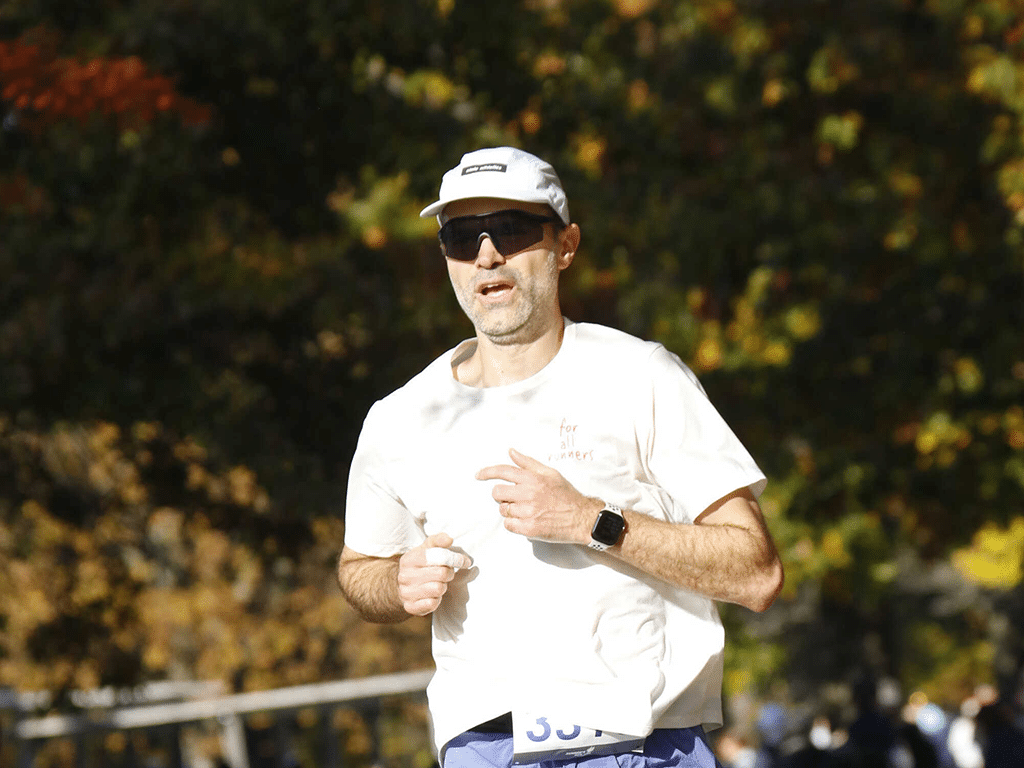
I recently ran my first half marathon in Hamilton. It was my first race of any kind in 11 years. One result surprised me. During the half, I ran a faster 10K segment than I did in my last race, a 10K back in 2015 where I set my personal best.
Before this summer, I’d never run more than 15 kilometers, let alone raced 21.
I’m certainly not fitter today than I was back then. (That was before kids!) So the faster split wasn’t about having more in the tank. It was about how I used what I had.
Getting back out there
I’d been looking to get back into a good fitness routine, and running felt familiar. I ran a lot during my Thoughtworks days, getting runs in after work when I was in NYC and Atlanta.
My neighbor was training for Hamilton, and that seemed like the perfect opportunity to jump on his bandwagon. It turns out we don’t run together much, but it was the nudge I needed. And a race on the calendar changes things. “I’ll go for a run tomorrow” doesn’t hold up when you know race day is coming.
Same runner, different approach
Back then, my idea of training mostly meant getting out there. I didn’t think about “builds,” and I didn’t really distinguish between easy runs, tempo workouts, and long runs. I’d just run more and hope it translated into a good race.
This summer, I followed a structured plan. I paid much closer attention to pacing and recovery. And I had a clearer idea of what each session was meant to accomplish.
Running has changed a lot in 11 years, or at least my understanding of it has. Nothing about my underlying capacity got bigger. What changed was how deliberately I used it.
The instinct to add more
When organizations want better results, the instinct is usually to add more: more people, more budget, more hours, more activity. Sometimes that’s the right call.
But better outcomes don’t always require greater capacity, more resources, or more effort. How intelligently we apply the capacity we already have can matter just as much.
That’s what my training this summer came down to. Each session had a purpose. I made better decisions about pacing and recovery. Over a few months, those deliberate choices compounded into a result I didn’t expect.
Teams work the same way. Deliberate practice, better decisions, and a clear sense of what each piece of work is for can compound into significantly better results. None of that depends on who has been around longest. It depends on whether a team keeps evolving how it approaches the problem.
Capacity in the age of AI
This matters more now than it did when I last raced. AI has handed almost every team more capacity, almost overnight. In our ebook, Work Intelligently, Marc De Pape and John Jarosz point out that when everyone gets the same speed and cost savings, those stop being advantages. They become the floor.
The instinct, again, is to add more: more output, produced faster, in the direction the team was already heading. Analysts from Bain and OpenAI, writing in Harvard Business Review, call this the “micro-productivity trap.” Teams speed up individual tasks without rethinking the workflows around them, and the gains never show up as business results.
That’s my old approach to training. Run more, and hope it translates into a good race.
The teams that get more from AI start somewhere else. They define what good looks like before they deploy. They decide which work deserves the capacity they free up. And they protect the human judgment that makes the work valuable.
It doesn’t always take AI, either. When Paycor set out to turn a suite built by acquisition into a single product experience, it already had a talented team. But the daily demands of building and maintaining products left little room to step back and look at the whole. Working alongside that team, we helped it apply its own ideas to the bigger picture. Anna Turner, then Paycor’s Senior Vice President of Product, Commercialization, & User Experience, said it got them in a few weeks to where it would otherwise have taken months. Same team, applied differently.
What’s next
I’m keeping at it. I run with BlackToe on Sundays, a great local running club, and their Holiday 10K in December should be a lot of fun. It’s also a good reason to keep up the training through the winter.
Next year, I’m running two iconic local half marathons. The Toronto Marathon in May starts close to my house at Yonge and Sheppard and runs down Yonge from there. In October, I’ll run the TCS Toronto Waterfront half, after cheering on some friends there this fall.
I haven’t discovered anything revolutionary about running. But the goal for each of these races isn’t to run more. It’s to keep getting better at applying the capacity I already have. That’s a pretty good goal for most teams, too.


