

For thirty years, every organization worked inside the same triangle: fast, cheap, or good — pick two. Every strategy, every resourcing decision, every tradeoff lived inside those constraints.

AI just collapsed two of its corners. Fast and cheap are now available to everyone, simultaneously, at what currently feels like negligible cost.

That should be the best news organizations have had in decades. It isn’t producing that result.

But when everyone has the same accelerant, fast and cheap stop being advantages — they become the floor. And that floor keeps dropping. The instinct, when a constraint disappears, isn’t to pause and ask what to do with the freed capacity. It’s to move faster in the direction you were already going: more output, more quickly, at lower cost.

The pattern is well documented by now. Writing in Harvard Business Review, analysts from Bain and OpenAI call it the “micro-productivity trap” — companies optimizing individual tasks without rethinking the workflows or the value creation around them, and never translating those isolated gains into real business results. The technology mostly works. The deployment choices don’t.

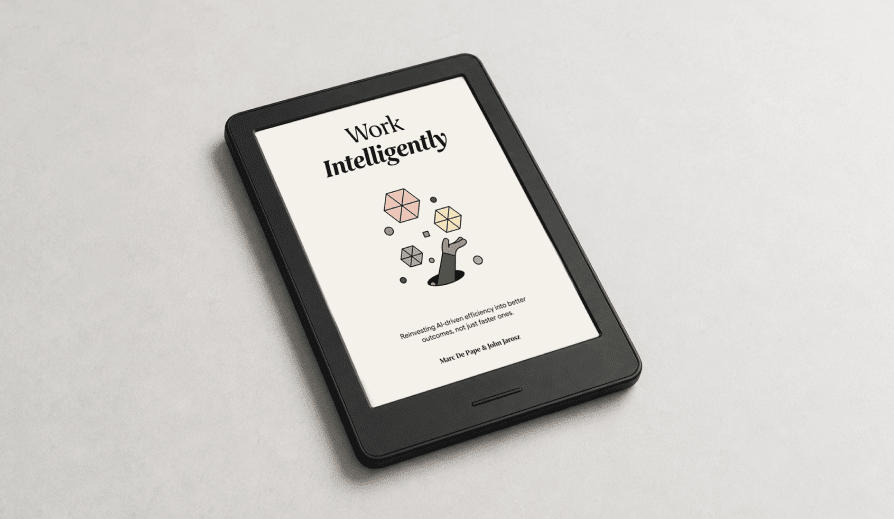
That gap is what our new ebook, Work Intelligently,  is about. It isn’t a framework for adopting AI faster. It’s a framework for deploying it deliberately — in ways that create real capacity, protect human judgment, and produce outcomes worth having. It rests on three principles.

Define good first. Most organizations skip this because it feels obvious — of course we want better results, lower costs, more efficiency. But those are directions, not destinations, and directions without destinations produce motion without progress. Until you’ve interrogated what good actually means for your organization, every efficiency AI creates gets absorbed by the same undifferentiated race it was supposed to help you escape.

Deploy vertically. A general-purpose tool pointed at an open-ended corpus can’t tell your people whether its output is reliable — so they verify it themselves, and the tool that was meant to free up capacity quietly adds a layer of oversight on top. Scope a deployment to a known, trusted body of knowledge and the opposite happens: it compresses the work between raw information and the decision that actually matters.

Protect the judgment layer. AI’s real superpower is surfacing the moments of discernment that used to take hours to reach. But asking people to execute more of those moments, with less cognitive room to do it well, is just a transfer of cost — from the visible effort of production to the invisible erosion of judgment. The work is designing AI to be a release valve on cognitive load, not an amplifier of it.

Aviation faced a version of this problem decades ago and answered it clearly: safer flights, not faster flights. Knowledge work is overdue for the same conversation.

If any of this sounds like a question worth answering, the ebook is the place to start.

Download the eBook: Work Intelligently: Reinvesting AI-driven Efficiency into Better Outcomes, Not Just Faster Ones by Marc De Pape & John Jarosz

Share this article